

The Rwenzori Organic Coffee Farmers Mountain Harvest Cooperative Society Limited (ROCS) is a dynamic Ugandan cooperative producing high-quality washed Arabica coffee for the European specialty market. Established in 2020 and now representing 1,025 smallholder farmers, ROCS has a clear ambition: to move from indirect supplier to direct international exporter, while securing the Organic and Fairtrade certifications that will finally deliver fair premiums to its members.

That journey is not without obstacles. Independent certification alone is quoted at $5,000, and working capital remains scarce. But through a partnership with the Trade for Development Centre (TDC) coaching programme, ROCS is putting in place the governance, due diligence and compliance systems, including preparation for the EU Deforestation Regulation (EUDR), that will underpin sustainable market access for years to come.
The TDC spoke with Moses Kyakora, ROCS’s Marketing Manager, and Alfred Kule, who leads much of the cooperative’s operational and compliance work, about the road travelled so far, and about what comes next.
A cooperative built by farmers, for farmers

ROCS was born out of adversity. “ROCS was officially established in 2020 following the COVID-19 pandemic,” Moses explains. “We are formally registered with the Ministry of Trade, Industry and Cooperatives of Uganda in 2023.” The cooperative began life with 724 smallholder coffee farmers who had organised themselves around micro-washing stations, with one clear focus: “producing washed Arabica coffee for the specialty market, particularly in the European Union.”
Growth has been steady rather than explosive, and deliberately so. “We have seen steady growth, increasing our membership from 724 to 1,025 smallholder farmers,” says Moses. “We have an ambitious target of reaching 2,000 farmers by 2027. That target aligns directly with EU organic regulations, which cap a certified producer group at 2,000 members. Once we hit that ceiling, we intend to stabilise our systems before potentially expanding further and exploring additional certifications.”
At its core, ROCS is a cooperative run for and by its members. “As a farmer-owned cooperative, we focus heavily on governance, empowering farmers to manage their own activities and washing stations,” Moses continues. “We also concentrate on our sustainability plan, which includes certification, and we provide training on good agronomic practices to ensure quality from the farm right through to export. We are involved in the entire coffee value chain, from production to export.”
Full traceability, from farm to export
 Ask Alfred what sets ROCS apart from other farmer organisations in the region, and the answer comes without hesitation: end-to-end support. “Our key differentiator is our support for farmers across the entire value chain,” he says. “We start with training in good agronomic practices at the farm level, continue with pre- and post-harvest support, and follow the coffee all the way to the final stages of the value chain. This end-to-end approach allows us to ensure both high quality and full traceability.”
In practice, that means close, hands-on engagement at every washing station.”We handle the pulping and washing of the coffee, maintaining a strong focus on quality so that our product is market-ready. We help farmers connect with local buyers, as most of our sourced coffee is sold on the local market, but our goal remains the international market, especially Europe, and that’s where the TDC coaching programme is vital in helping us meet international trade standards.”
A bridge to European markets
Moses’s role gives ROCS an unusually direct line into the European coffee trade. “My role involves developing ROCS’s market strategy for both local and international markets,” he says. “I also serve as the country representative in Uganda for Supremo N.V., a Belgian company and a major player in the coffee chain with offices in Bruges. This connection gives ROCS a direct bridge to international exposure.” He also puts his own expertise to work training the next generation of ROCS farmers: “I leverage my background as a qualified consultant to train our farmers through ROCS’s extension department. This training covers proper coffee handling, understanding quality and outturn, and developing negotiation skills, for example, by helping them learn how to price their coffee per kilogram to improve their standing with local buyers.”
Yet knowledge alone is not enough to break into direct export. “We possess the knowledge of international markets, Incoterms, and other key aspects of export,” Moses says. “What we lack are adequate financing and robust partnerships. Securing sufficient working capital is essential for us to move away from indirect trading and export our quality coffee directly, which will ultimately ensure better prices for our farmers.”
For now, ROCS coffee reaches Europe via intermediaries. “I’ve linked several cooperatives and companies to buyers like Supremo and Sustainable Harvest,” Moses says. “We pool a small amount of capital to buy coffee from farmers, bulk it, and then sell it to these intermediary companies, who in turn export it. Therefore, ROCS is currently an indirect supplier, but we are actively seeking finance to transition to direct export.”
The cost of independence: finance and certification
 Access to affordable credit is central to that transition. ROCS has already made progress on this front, working with several social lenders. “We have engaged with social lenders such as Root Capital, Progreso, and Shared Interest and successfully negotiated interest rates down from 11-12% to about 8-9%,” says Moses. “Our goal is to achieve rates of around 5–6% to prevent a large portion of our farmers’ margins from being consumed by financing costs.”
Certification tells a similar story of a cooperative determined to stand on its own feet. “ROCS as an independent cooperative is not yet certified,” Alfred confirms. “However, our farmers are currently included under the organic and Fairtrade certifications held by another cooperative union. A key reason for forming ROCS was that our farmers were not receiving their rightful premiums under that union.”
With Enabel’s support and guidance from the coaching programme, ROCS is now working to change that. “We aim to withdraw from that shared certificate and gain independent certification,” Alfred explains. “We have completed the groundwork, including farmer registration and geolocation profiling. We’ve received a quotation from Control Union, with organic certification for 2,000 farmers estimated at $3,000 and Fairtrade at $2,000. Finance remains our main obstacle.”
Coaching that builds ownership
ROCS found its way to the Trade for Development Centre almost by chance, and then through its own network. “We initially found the Trade for Development Centre through a web search while looking for partners,” Alfred recalls. “We also heard about the call for applications via our cooperative union. We applied and were fortunate enough to be selected for the coaching.”
What has followed, under the guidance of local coach Godfrey Lutwama, is described in glowing terms. “We see Godfrey’s coaching as an important stepping-stone,” says Alfred. “It is highly practical and deeply grounded in our local situation, using relevant examples from similar cooperatives like Bugisu Cooperative Union (BCU) in Mount Elgon. He guides us in a structured way, but we are responsible for developing the content ourselves, the policies, procedures, and tools, which reinforces our ownership of the process.”
That coaching now touches almost every strand of ROCS’s compliance work. “For us, these are a chain of interconnected activities,” Alfred says. “Our priorities are to finalise farmer certification, continue with geolocation, and ensure compliance with the EU Deforestation Regulation (EUDR) requirements. The coaching has been important, providing us with knowledge on standards and requirements that many other organisations lack. Godfrey is helping us develop our own Human Rights and Environmental Due Diligence (HREDD) policies”.
The results, Alfred says, are already tangible. Among the concrete achievements he lists: internal policies developed, including on gender and human resources; a completed SWOT analysis giving the cooperative “a clear picture of our strengths, weaknesses, opportunities, and challenges”; knowledge gained on coffee standards and EU requirements; advanced preparation for independent certification “to secure premium prices for our farmers”; and a strengthened team, with a dedicated HREDD focal person now in place.
Not every task is finished, however. “We’ve made progress but haven’t fully completed the geolocation for all members yet,” Alfred admits. “We need correct polygon data to build a robust traceability system.”
La certification fait aussi partie du récit d’une coopérative déterminée à se tenir debout par elle-même. « La ROCS, en tant que coopérative indépendante, n’est pas encore certifiée », confirme Alfred. « Cependant, nos agriculteurs sont actuellement inclus dans les certifications biologique et commerce équitable détenues par une autre union de coopératives. Une raison clé de la création de la ROCS a été la non-perception par les agriculteurs des primes qui leur étaient dues. »
Avec les conseils d’Enabel dans le cadre du programme de coaching, la ROCS travaille maintenant à changer cela. « Nous visons à nous retirer de ce certificat partagé et à obtenir une certification indépendante », explique Alfred. « Nous avons effectué le travail de base, y compris l’enregistrement des agriculteurs et le profilage par géolocalisation. Nous avons reçu un devis de Control Union, avec une certification biologique pour 2 000 agriculteurs estimée à 3 000 dollars et une certification Fairtrade à 2 000 dollars. Le financement reste notre principal obstacle. »
Coaching that builds ownership
ROCS found its way to the Trade for Development Centre almost by chance, and then through its own network. “We initially found the Trade for Development Centre through a web search while looking for partners,” Alfred recalls. “We also heard about the call for applications via our cooperative union. We applied and were fortunate enough to be selected for the coaching.”
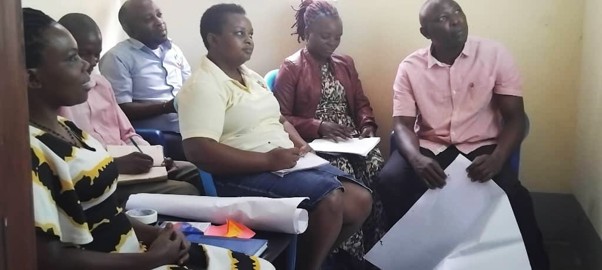 What has followed, under the guidance of local coach Godfrey Lutwama, is described in glowing terms. “We see Godfrey’s coaching as an important stepping-stone,” says Alfred. “It is highly practical and deeply grounded in our local situation, using relevant examples from similar cooperatives like Bugisu Cooperative Union (BCU) in Mount Elgon. He guides us in a structured way, but we are responsible for developing the content ourselves, the policies, procedures, and tools, which reinforces our ownership of the process.”
That coaching now touches almost every strand of ROCS’s compliance work. “For us, these are a chain of interconnected activities,” Alfred says. “Our priorities are to finalise farmer certification, continue with geolocation, and ensure compliance with the EU Deforestation Regulation (EUDR) requirements. The coaching has been important, providing us with knowledge on standards and requirements that many other organisations lack. Godfrey is helping us develop our own Human Rights and Environmental Due Diligence (HREDD) policies”.
The results, Alfred says, are already tangible. Among the concrete achievements he lists: internal policies developed, including on gender and human resources; a completed SWOT analysis giving the cooperative “a clear picture of our strengths, weaknesses, opportunities, and challenges”; knowledge gained on coffee standards and EU requirements; advanced preparation for independent certification “to secure premium prices for our farmers”; and a strengthened team, with a dedicated HREDD focal person now in place.
Not every task is finished, however. “We’ve made progress but haven’t fully completed the geolocation for all members yet,” Alfred admits. “We need correct polygon data to build a robust traceability system.”
Coaching feedback and future plans
Asked to sum up the working relationship with the coach, Alfred does not hesitate: “The relationship is excellent. He provides guidance and then gives us time to work on assignments, which allows us to take ownership and address identified gaps. We particularly appreciate that TDC selected a local coach.”
If there is one area for improvement, it is where the coaching takes place. “Most coaching currently takes place in the ROCS office,” Alfred notes. “We would benefit greatly from more field-based coaching involving both board members and farmers. For example, if a mission is five days, two days in the field and three days in the office would be ideal. Field sessions are more interactive and impactful, and would streamline the process of discussing policies with the board and farmers.”
Overall, though, the verdict is a strongly positive one. “We would rate the coach between seven and eight out of ten,” says Alfred. “He is practical and focused on real issues, guiding us while we execute the actual work, which is exactly what coaching should be.”
Looking ahead, ROCS’s priorities for the next two years are clear: “achieve access to EU markets by completing geolocation and meeting certifications standards and intensifying resource mobilisation efforts. The cooperative is also looking to broaden the scope of support it receives: “We also request further team coaching on marketing, both locally and internationally, to support Moses’s leadership in this area.”
This interview was conducted by Samuel Poos, Project Manager of Enabel’s Trade for Development Centre.
Photos
– ROCS farmers engagement meeting
– Women Working on coffee quality at the micro washing station
– Rwenzori washed arabica coffee
– The ROCS technical team is receiving HREDD coaching with support from Enabel’s TDC.
